
Building Smarter Startups
Practical founder insights, AI startup spotlights, and real lessons from the trenches — so you can build faster, avoid costly mistakes, and scale with more clarity.

This month’s newsletter brings together a mix of ideas, practical learning, and a couple of projects worth paying attention to.
First, there are two short educational pieces that explore how founders and operators can think more clearly about growth, customer acquisition, and building authority through content. They’re grounded in practical experience rather than theory, and designed to give you something useful you can apply immediately.
Alongside that, there are two spotlight features. One highlights Apex Lab, whose work on rapid AI prototyping is helping early-stage founders turn ideas into working products in a matter of weeks through their AWS-backed accelerator programme. The other looks at FlowLinker, a young company building an AI-powered “Specs Engine” to extract critical technical requirements from messy sales conversations and turn them into structured deal intelligence.
And finally, at the end of the newsletter there’s a short update from me — a small personal note about training, a weekend hiking plan that may evolve into something more ambitious later in the year, and a slightly humbling paella-making competition with my Spanish neighbour.
Interested to learn more about my services? Check out my website www.bensheppard.xyz
The Danger of the “Dream Client”
One of the patterns I have seen repeatedly while working with founders is what I think of as the “dream client” problem. At some point in almost every early-stage company, a lead appears that seems unusually significant. It might be a well-known brand, a large enterprise, or someone influential in the market the founder wants to enter. Very quickly, that opportunity begins to take on a special status in the founder’s mind. Instead of being treated as just another potential customer, it becomes the client that might validate the product, accelerate growth, and unlock credibility with the rest of the market.
Once that mental shift happens, behaviour often changes in subtle but important ways. Rather than contacting the organisation early and simply exploring whether there is a real opportunity, founders frequently delay the conversation. They want the product to be a little stronger first, the messaging a little clearer, the demonstration a little more polished. Preparation, in principle, is sensible. In practice, it often becomes a form of avoidance. Weeks pass, sometimes months, and during that time the opportunity grows in importance inside the founder’s imagination. The potential deal begins to feel transformative long before anyone has actually established whether the customer has a genuine need.
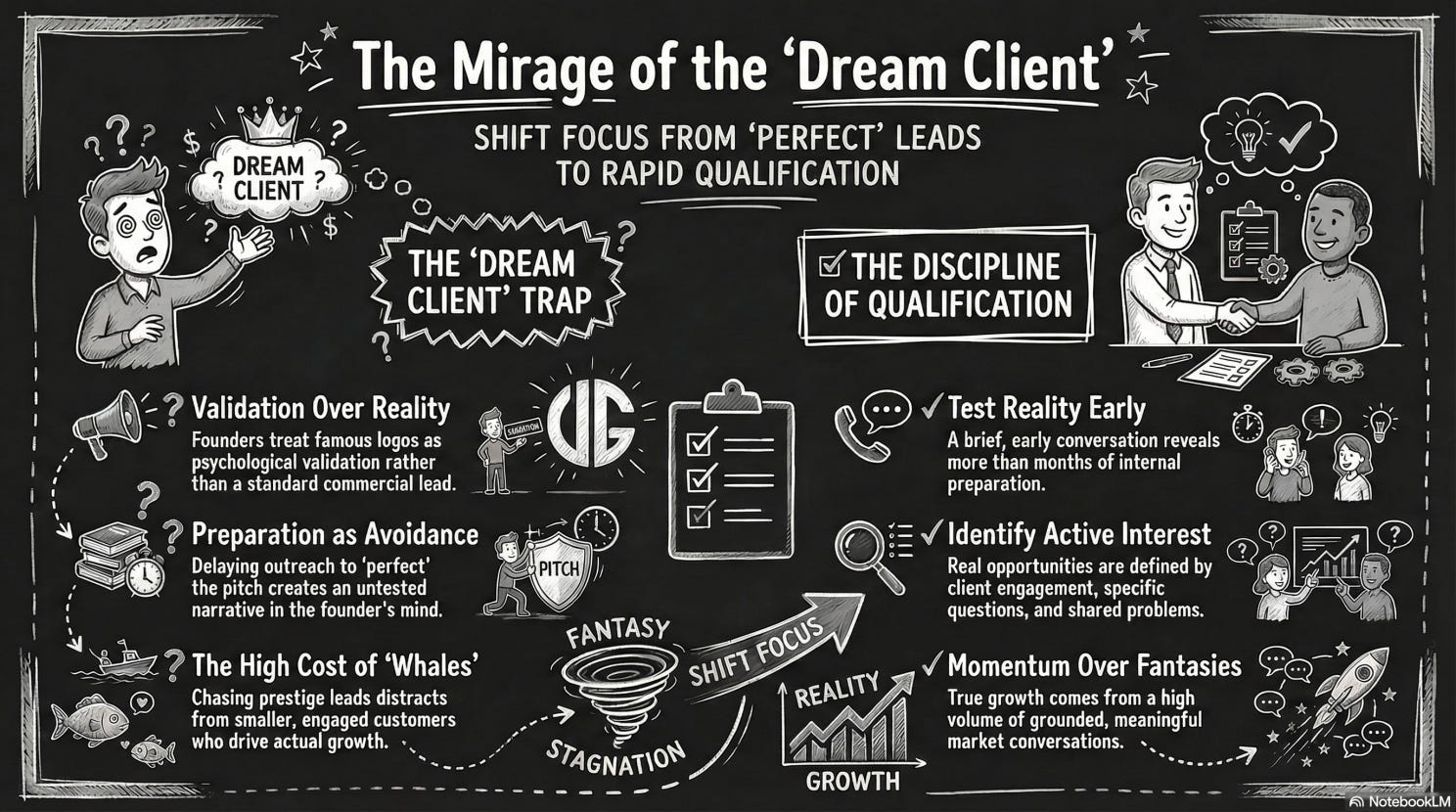
I saw this dynamic play out with a founder some years ago who had been trying to connect with a senior figure at a large banking institution. Through a series of introductions and occasional messages, the possibility of working together began to feel increasingly promising. Over time, the lead became something the founder thought about constantly. When a meeting was eventually arranged at an industry event, expectations were understandably high. Yet when the interaction finally happened, the reality was very different from the narrative that had developed. The conversation was brief, distracted, and impersonal. There was little engagement with the product and no meaningful discussion of the problem it was designed to solve. Within minutes the interaction was over, and it became clear that the opportunity had never been what the founder believed it to be.
Situations like this are more common than many founders realise. The real cost is not simply the wasted meeting or travel. It is the emotional energy spent anticipating a breakthrough that was never truly there, and the distraction from other opportunities that may have been far more genuine. Companies build momentum through real conversations with customers who are prepared to engage, not through imagined deals that grow larger only inside the founder’s head. The discipline is therefore straightforward: qualify leads early, test assumptions quickly, and resist the temptation to place any potential client on a pedestal before the reality of the opportunity has been properly understood.
The Founder’s Relationship with Uncertainty
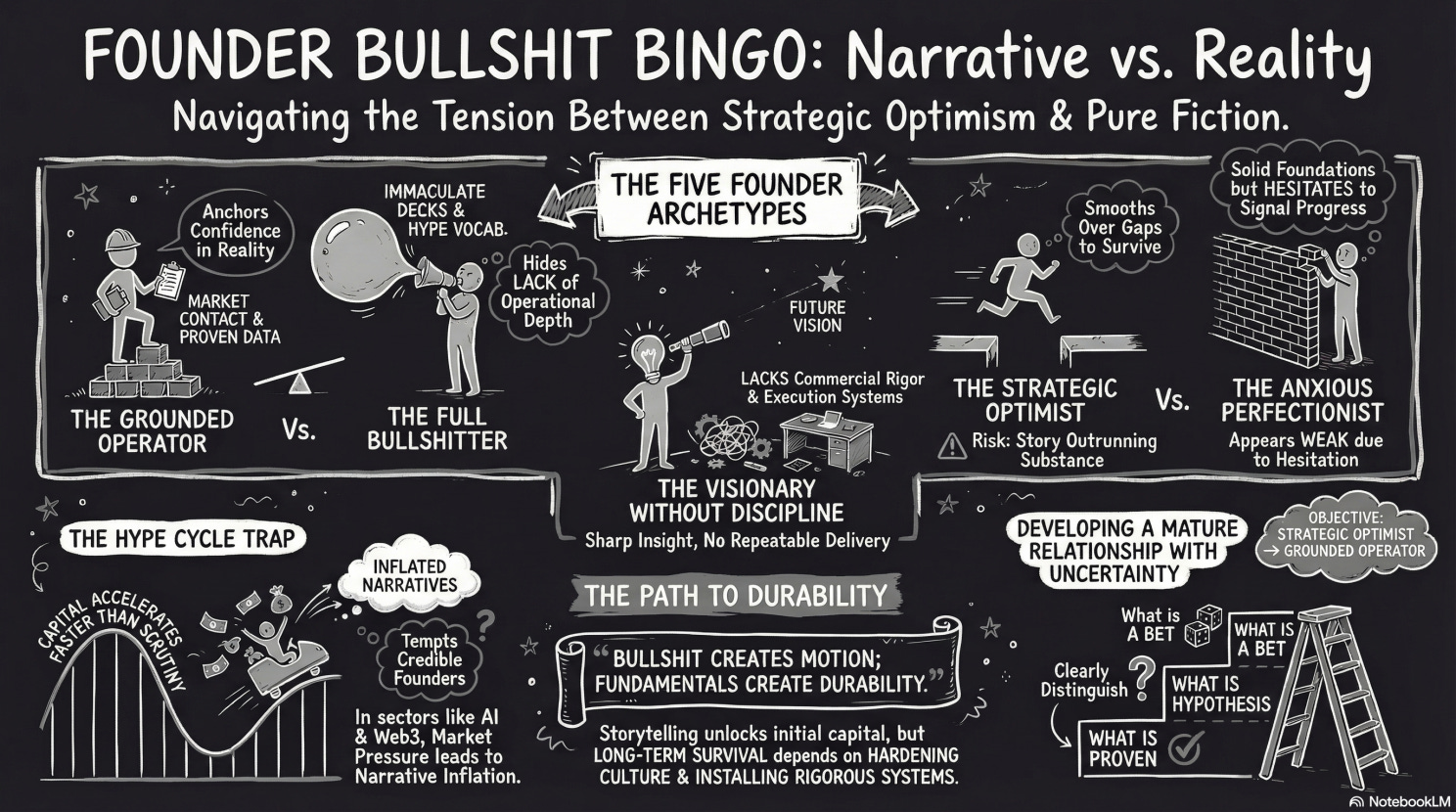
In the high-stakes world of early-stage startups, a founder’s success is often defined less by their competence and more by their relationship with uncertainty. While some founders walk into a room with grounded clarity, others are more fluid with reality—smoothing over gaps in evidence with polished narratives designed to unlock capital.
This tension between “selling the future” and “operational reality” leads to five recurring archetypes:
The Grounded Operator: Anchored in reality, they distinguish clearly between what is proven and what is still a hypothesis.
The Strategic Optimist: Projects certainty to secure resources, hoping to close the gap between their story and substance before it becomes a problem.
The Full Bullshitter: Replaces fundamentals with current vocabulary and grand ambition, often thriving only in overheated markets where storytelling is rewarded over delivery.
The Anxious Perfectionist: Possesses solid foundations but hesitates to signal progress due to a lack of courage rather than a lack of substance.
The Visionary Without Operator Discipline: Sees a compelling future but lacks the execution systems and commercial rigour to make it repeatable.
Ultimately, bullshit can create motion, but it rarely creates durability. The market eventually sorts these archetypes, rewarding those who develop the discipline to project conviction without detaching from evidence.
Spotlight Project – Developed by Apex Lab: Upsail, an AI-Powered Boat Charter Booking Platform
Upsail is a global rental technology platform developed by Apex Lab that demonstrates how generative AI can transform the booking experience in the charter industry. The goal of the project was to build an AI-powered platform that allows customers to discover and book boats through natural language conversations rather than navigating traditional booking websites.
The system connects directly to the Booking Manager API, enabling real-time access to boat availability, pricing, and charter information. Instead of submitting enquiries and waiting for manual responses, users can ask questions conversationally and receive immediate booking options through an AI interface.
Technically, the platform integrates conversational AI with real operational systems. ChatGPT connectivity allows reservations to be managed through natural language interactions, while a customer service agent powered by retrieval-augmented generation uses Amazon Bedrock and OpenSearch to provide accurate responses from indexed documentation and platform data. The backend runs on a serverless AWS architecture using Lambda microservices to handle reservations, payments, notifications, and data retrieval.
The result was a production-ready conversational booking platform that reduced booking times from hours to minutes while increasing conversion rates through guided AI interactions. Charter companies also benefited from lower operational overhead as many customer service enquiries were automated. The project demonstrates how generative AI can act as an intelligent interface between customers and complex booking infrastructure.
Projects like Upsail are exactly the type of initiative supported through Apex Lab’s GenAI Accelerator Program, which is backed by AWS grants. The program is designed to help founders move from an idea to a working AI prototype in just four to six weeks.
The process begins with an initial qualification and discovery session, followed by a focused workshop that evaluates the opportunity and prioritises the most valuable AI use case. Once the architecture and scope are defined, Apex Lab builds a working proof of concept using AWS AI services and cloud infrastructure.
Because the program is supported by AWS funding, founders can often access the development resources needed to build a prototype without any upfront cost. By the end of the accelerator, participants have a functional prototype and a clear roadmap for scaling the system into a full MVP.
For early-stage founders—especially those who are strong on business but do not yet have a development team—the program offers a rapid and low-risk way to validate AI product ideas and bring them to life.
If you are interested to learn more about the Apex Lab AI accelerator and whether your project is a good fit for the AWS Grant, DM me and let’s chat.
Spotlight: FlowLinker – Building a Startup the Right Way
I’ve known one of the FlowLinker founders, Khadija Mebtoul , for almost a year now. Her fellow co-founder, Francis Lavallee -- hiring Founding Ai Engineer , I got to know more recently. And I have to say, I absolutely love these two to bits. As a business coach, you start to recognise patterns. Sometimes when founders come to you, it’s relatively easy to offer advice because there are obvious things that need fixing. Other times it’s harder — because the founders in front of you are already doing most things right. That was my experience with Khadija and her co-founder.
When we first spoke in Q2 last year, Khadija told me how the two of them had essentially locked themselves away in a basement somewhere in Canada and built the first version of their product. It wasn’t built in isolation or based on abstract ideas. It was built around a problem they knew deeply from their own experience working in technical sales, and they built it with real customers in mind from day one. Within the first couple of months of launching, they already had paying customers and recurring revenue. Not vanity traction — genuine MRR that proved the problem was real and the product solved something meaningful.
That early validation positioned them perfectly for their first investment from Antler, one of the world’s leading venture investors. But what impressed me most was what happened next. They didn’t slow down. They didn’t try to protect what they had already built. Instead they doubled down — reinvesting the capital into improving the technology, expanding the customer base, and continuing to evolve the product. Now they’re entering their next fundraising phase from a much stronger position because they used that first round of capital properly. When I last spoke with them, they had been working just as hard over Christmas as they had been when they first launched the company. Khadija told me she’d had about three days off. That level of commitment tells you a lot about founders.
The product they’re building is genuinely interesting too. If you want to see it yourself, take a look here:
https://www.flowlinker.ca/
. FlowLinker is tackling a problem anyone in technical sales will recognise. In complex deals, the most important information — technical specifications, constraints, and requirements — often ends up scattered across emails, meeting notes, CRM systems, and Slack conversations. By the time the deal progresses, critical details are often lost or misinterpreted.
FlowLinker solves this with what they call the Specs Engine, an AI system designed specifically for technical sales teams. The platform automatically joins calls, captures technical requirements discussed in conversations, and pulls information from emails, documents, and internal tools to create a structured, shared record of every deal. It can even flag missing information, identify risks, and suggest follow-up questions while the conversation is happening.
In other words, instead of messy conversations and scattered notes, sales teams end up with a clear, validated view of every requirement across the deal lifecycle. That keeps sales, engineers, and customers aligned and dramatically reduces the chances of missed specifications or painful rework later in the process. And this isn’t some ChatGPT wrapper. This is far more complex and has been built with specific industries in mind, which gives it a serious moat against rival products.
In industries like robotics, manufacturing, and industrial automation — where deals are complex and technical mistakes are expensive — that kind of clarity is incredibly valuable. FlowLinker is effectively creating a system of record for technical intent. And when you combine a strong problem with founders who genuinely understand the industry — and who execute the way Khadija and her co-founder do — you end up with the kind of startup that is very hard to bet against.
Personal Update
A small update from my side before we wrap up. HYROX ESP training is continuing to go really well. I’ve been much more patient with the training this time around — running slower and keeping the distances shorter. It’s not glamorous, but the difference is noticeable. My body isn’t falling apart like it has done in the past. I’m now in week nine of consistent training, and I feel great.
This weekend I’m doing something slightly different. A group of friends and I are heading off for a couple of days of hiking. Rob Holmes is one of them. It’s not a massive challenge — 25 km on day one and 35 km on day two — but I do have a slightly longer-term plan. My real goal is to recruit these boys into joining me later this year for a 100 km hike. So this weekend is essentially my attempt to gently introduce them to the joys of walking very long distances and see how receptive they are. We’ll see how that goes.
The other update from last weekend is that I participated in a paella-making competition with my Spanish neighbour. Unsurprisingly, I lost. To be fair, the contest may have been slightly unfair from the start. An Englishman attempting paella versus a native Spaniard who has probably been cooking it since childhood was always going to be a tough match-up. And to his credit, his paella was genuinely exceptional — in my opinion, bordering on Michelin-star territory. Mine wasn’t terrible, but the difference was obvious the moment we tasted them side by side. Safe to say I won’t be quitting my day job anytime soon!

Interested to learn more about my services? Check out my website www.bensheppard.xyz